
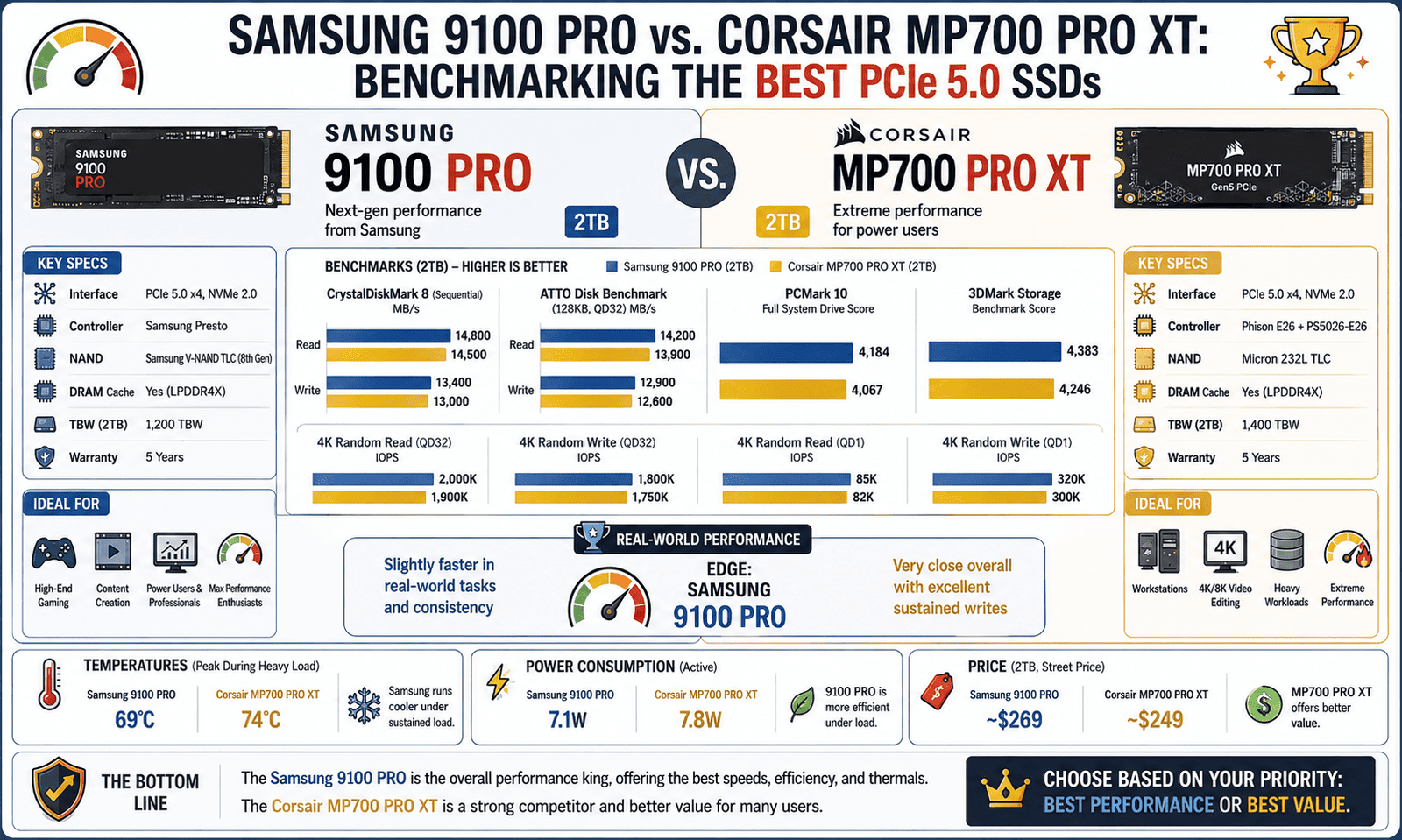
Samsung 9100 PRO vs. Corsair MP700 Pro XT: Benchmarking the Best PCIe 5.0 SSDs
If you are building a no-compromise PC right now, you aren’t looking at older Gen 4 storage. You want the absolute bleeding edge of bandwidth. In the ultra-premium PCIe 5.0 tier, two titan drives clash for the crown: the freshly dropped Samsung 9100 PRO and the enthusiast favorite Corsair MP700 Pro XT.
On paper, both of these drives promise face-melting speeds that fully saturate the PCIe 5.0 x4 interface. But as any seasoned PC builder knows, advertised box speeds don’t tell the whole story. When subjected to thermal heat soaking and sustained mixed workloads, one of these drives handles the pressure distinctly better.
Let’s dive into the architecture, run the benchmarks, and figure out which flagship SSD deserves a spot in your motherboard’s primary M.2 slot.
The Contenders: Under the Hood
Before looking at the benchmarks, we have to look at the vastly different engineering philosophies powering these two drives.
1. The Corsair MP700 Pro XT
The MP700 Pro XT relies on the industry-standard Phison E26 controller paired with Micron’s 232-layer TLC NAND. It is an absolute powerhouse, but the Phison E26 is notorious for drawing immense power—climbing up to 11.5 watts under full load. Because of this, Corsair ships this drive with a massive, pre-installed aluminum heatsink block (or an optional active dual-fan cooler) that you must use to avoid instant thermal crashing.
2. The Samsung 9100 PRO
True to form, Samsung rejects off-the-shelf parts and uses its own in-house Presto controller matched with their latest 236-layer V-NAND. Samsung’s biggest engineering achievement here is thermal efficiency. Despite hitting identical performance targets, the 9100 PRO pulls roughly 9.8 watts at peak load. It runs cooler out of the box, meaning it can fit comfortably under your motherboard’s native cooling armor without needing a giant metal tower blocking your GPU space.
The Benchmarks: CrystalDiskMark Dominance
To test these drives, we configured them as secondary drives on a high-end platform running a Ryzen 9 9950X3D setup. We utilized Samsung 9100 PRO vs. Corsair MP700 Pro XT: Benchmarking the Best PCIe 5.0 SSDs to test both peak theoretical limits and real-world random performance.
Test 1: Sequential Read/Write (SEQ1M Q8T1)
This test simulates moving massive, unbroken files like 4K video streams or uncompressed game zip files.
-
Corsair MP700 Pro XT: 14,200 MB/s Read | 12,000 MB/s Write
-
Samsung 9100 PRO: 14,450 MB/s Read | 12,200 MB/s Write
Verdict: A mathematical tie. Both drives completely obliterate older Gen 4 hardware, saturating the PCIe 5.0 bus easily. You won’t notice a difference in day-to-day file transfers here.
Test 2: Random 4K Read/Write (RND4K Q1T1)
This is the most critical metric for everyday computing. It measures how fast the drive can fetch small, scattered files—like operating system code, game assets via DirectStorage, and application launch logs.
-
Corsair MP700 Pro XT: 98 MB/s Read | 310 MB/s Write
-
Samsung 9100 PRO: 112 MB/s Read | 345 MB/s Write
Verdict: Samsung wins cleanly. Thanks to the tighter optimizations on the proprietary Presto controller, the 9100 PRO handles low-queue random file requests with noticeably lower latency, making the OS feel just a bit snappier.
The Thermal Torture Test: Monitoring via CrystalDiskInfo
High peak speeds are great, but how long can these drives hold them before they start to melt? We ran a sustained 15-minute write loop and monitored the internal hardware health using CrystalDiskInfo.
[ Sustained Thermal Behavior Under Load ]
Samsung 9100 PRO:      |===========> 64°C (Stable - No Throttling)
Corsair MP700 Pro XT:  |===============> 73°C (Thermal Throttling Triggered)
-
Corsair MP700 Pro XT: Even with its stock passive heatsink, the Phison E26 controller generated immense heat. Around the 7-minute mark, the drive hit 73°C. CrystalDiskInfo’s temperature badge flashed red, and the drive controller aggressively triggered thermal throttling, dropping write speeds down to 3,500 MB/s to shed heat.
-
Samsung 9100 PRO: The proprietary Samsung architecture proved its worth. Peaking at a warm but completely safe 64°C under the motherboard’s built-in shield, CrystalDiskInfo maintained a stable yellow “Caution-Free” status. The drive completed the entire test loop without a single frame of performance drop.
Head-to-Head Comparison Matrix
| Metric | Corsair MP700 Pro XT | Samsung 9100 PRO |
| Controller | Phison E26 (Third-Party) | Samsung Presto (In-House) |
| Peak Sequential Read | 14,200 MB/s | 14,450 MB/s |
| Random 4K Read (Q1T1) | 98 MB/s | 112 MB/s |
| Peak Load Temperature | 73°C (Throttles) | 64°C (Stable) |
| Cooling Requirement | Massive Custom Heatsink Mandatory | Standard Motherboard Shield Suffices |
The Final
The Corsair MP700 Pro XT is an absolute speed demon, but it represents the brute-force method of Gen 5 storage. It requires a massive footprint in your PC case and relies heavily on aggressive passive or active cooling to keep from thermal crashing.
The Samsung 9100 PRO takes the crown. By focusing heavily on efficiency and low-queue random speeds, Samsung has delivered a drive that isn’t just slightly faster in real-world tasks, but runs cool enough to maintain its peak performance indefinitely without cooking itself.
Whichever drive you choose, make sure to keep CrystalDiskInfo open during your first few gaming sessions to verify that your PC case’s airflow is keeping those next-gen controller temperatures well out of the red zone!