
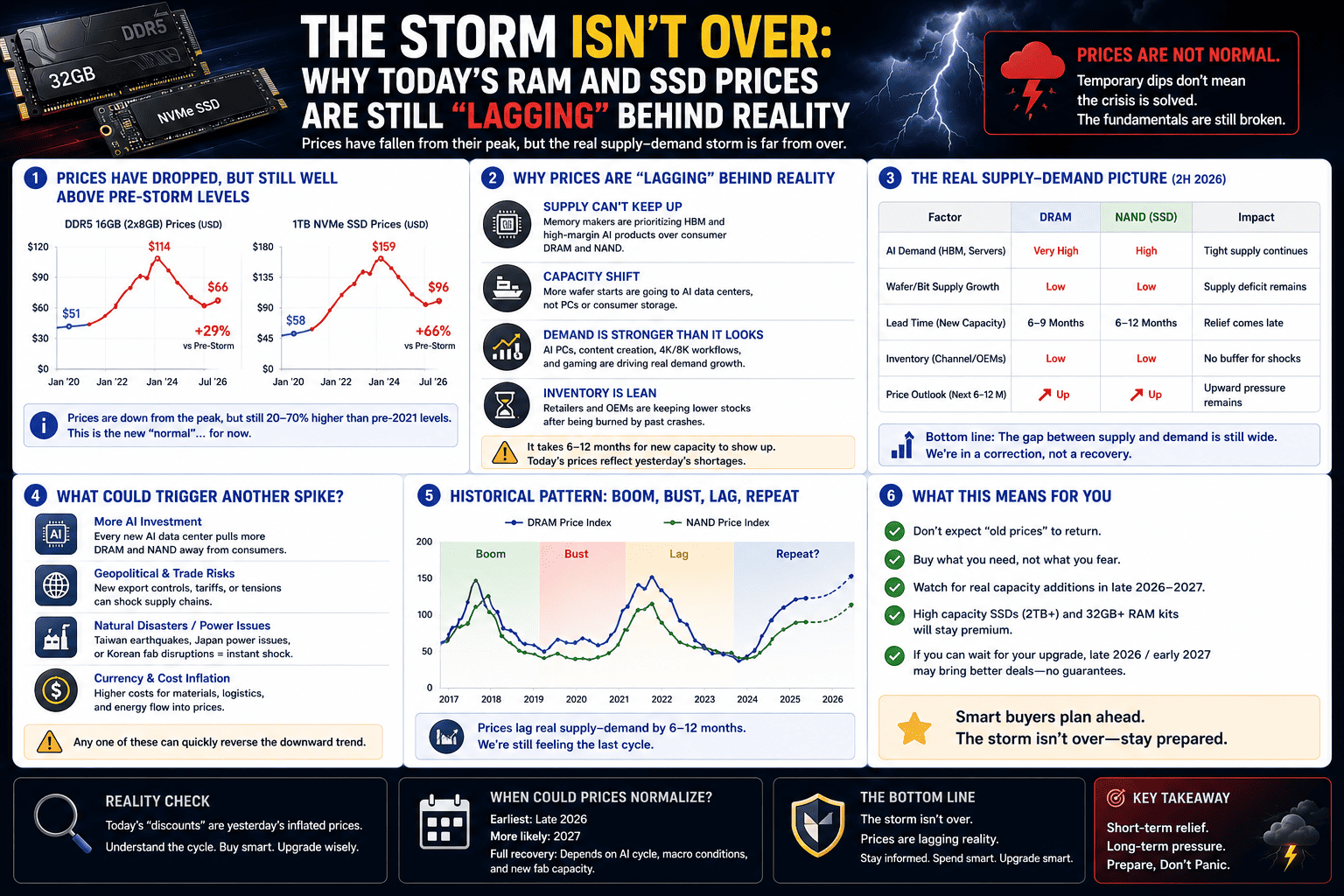
The Storm Isn’t Over: Why Today’s RAM and SSD Prices Are Still “Lagging” Behind Reality
If you thought current RAM and SSD prices were already painful, Valve has a sobering message for the DIY PC community: the retail market hasn’t even felt the worst of it yet.
In a conversation with Bloomberg regarding the development and launch of the $1,049 Steam Machine, Valve hardware engineers Yazan Aldehayyat and Pierre-Loup Griffais dropped a stark warning about the state of component pricing. According to Valve’s internal tracking across global hardware supply chains, retail prices sitting on store shelves right now are lagging behind bulk wholesale costs by at least three to six months.
What you are paying at retail today isn’t reflecting current memory production costs—it reflects older inventory that vendors bought months ago. Once those older stocks dry up, the real price hikes will hit store shelves.
“Honestly, It’s Still Getting Worse”
When asked about the trajectory of component costs, Aldehayyat didn’t sugarcoat the situation:
“Honestly, it’s still getting worse. What people are seeing on retail shelves right now, from our observations, is lagging what we’re seeing from bulk supply by at least three to six months.”
This lag explains why pre-built machines and boutique consoles like the Steam Machine have seen elevated price tags. Valve engineer Pierre-Loup Griffais noted that memory capacity constraints are actively capping how many units the company can build: “We’re basically building everything we can get our hands on.”
[ Wholesale Supply Price Hike ] ──( 3 to 6 Month Delay )──> [ Retail Store Shelf Price Spike ]
When wholesale NAND flash and DRAM prices surge, retailers don’t immediately re-tag existing inventory. Instead, price increases filter down in waves as distributors exhaust older stock and reorder at higher contract rates.
Why Memory Costs Keep Escalating
Valve’s observations match broader industry forecasts from research firms like TrendForce and Gartner. The root cause remains an aggressive structural shift toward enterprise infrastructure:
-
The AI Memory Drain: Fabrication giants like Samsung, SK Hynix, and Micron continue reallocating silicon wafer capacity away from consumer DDR5 and client NVMe flash to produce high-margin HBM (High Bandwidth Memory) and high-density server V-NAND for AI data centers.
-
Depleted Buffer Inventories: PC manufacturers and component vendors built up inventory cushions in late 2025, but those buffers are now depleted.
-
No Quick Relief: Analysts predict DRAM and NAND contract prices will continue climbing through 2026 and well into 2027, with meaningful market relief not expected until 2028 at the earliest when new fabrication facilities (fabs) come online.
What This Means for PC Builders
If you are planning an upgrade or building a system, here is how to navigate the current market landscape:
| Scenario | Market Reality | Recommended Action |
| Urgent Need (Broken Drive/RAM) | Prices will likely be higher in 3–6 months than today. | Buy now. Retail stock still reflects older, lower wholesale contract rates. |
| Optional Upgrade (More Storage) | High-density 2TB/4TB NVMe drives are at multi-year price peaks. | Wait it out. Maintain existing drives and offload non-essential files. |
| Handheld / SFF Upgrades | Compact M.2 2230/2240 drives are seeing tight supply. | Monitor drive wear and thermals to maximize current drive lifespan. |
The Takeaway: Audit What You Already Own
Before spending inflated prices on replacement storage, audit your current drives using CrystalDiskInfo:
-
Check Your Health Percentage: Review your primary NVMe drive’s
Health Status. If it sits above 85–90%, you have plenty of operational life left. -
Monitor Total Host Writes: Compare your cumulative write volume against your drive’s rated TBW (Terabytes Written). Most users consume less than 10–15% of their drive’s physical cell endurance per year.
-
Manage Heat: Ensure your active drive thermals stay under 60°C to prevent heat-induced wear on the memory controller.