
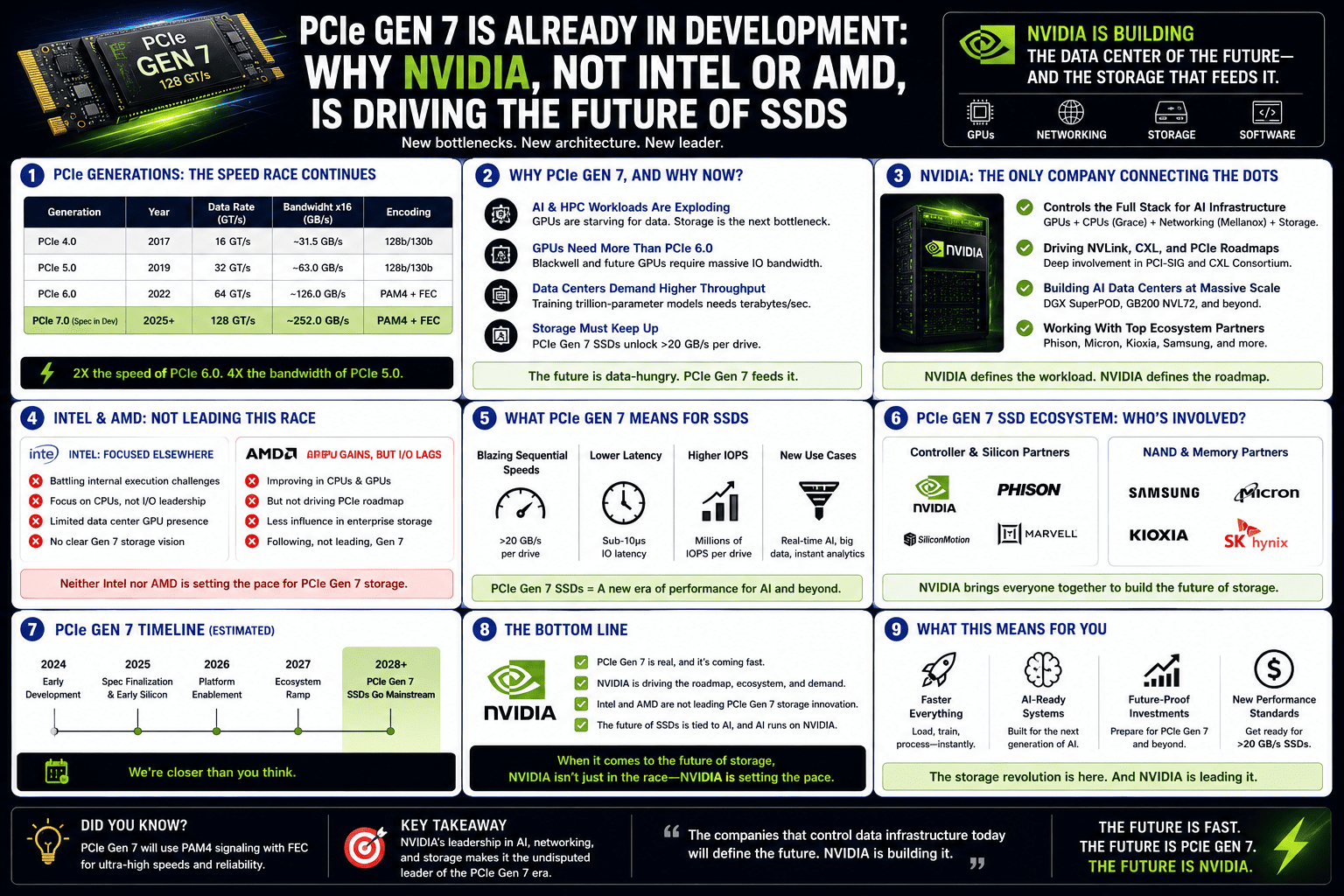
PCIe Gen 7 is Already in Development: Why NVIDIA, Not Intel or AMD, is Driving the Future of SSDs
Just as consumer PC builders are beginning to adopt PCIe Gen 5 and Gen 6 hardware, the storage industry is already planning its next leap forward.
According to executive statements from Silicon Motion (SMI)—one of the world’s leading independent SSD controller makers—development for PCIe Gen 7 controller architecture is officially underway.
The most surprising revelation isn’t just the sheer speed of Gen 7. It’s who is pushing controller manufacturers to move at this breakneck pace. Silicon Motion revealed that NVIDIA, through its enterprise and AI-driven “Storage Next” initiatives, is currently driving their next-gen consumer and client SSD roadmaps—bypassing traditional desktop CPU heavyweights like AMD and Intel.
Here is what the shift to PCIe Gen 7 and Gen 6 means for the future of consumer storage, hardware thermals, and everyday PC performance.
The Roadmaps: PCIe Gen 5 to Gen 7 Progression
The speed jump across PCIe Express generations is expanding rapidly. However, each doubling of bandwidth presents new thermal and power management challenges for M.2 controllers:
[ PCIe Gen 5 x4 ] ──> ~14.5 GB/s  (Current Flagships / Heavy Cooling Needed)
[ PCIe Gen 6 x4 ] ──> ~25.0 GB/s  (Silicon Motion "Neptune" / PAM4 Encoding)
[ PCIe Gen 7 x4 ] ──> ~60.0 GB/s  (In Active R&D / Target 2028-2030)
1. The Immediate Step: PCIe Gen 6 (Codename: Neptune)
Silicon Motion’s upcoming consumer PCIe 6.0 controller, codenamed Neptune, promises sequential read speeds exceeding 25 GB/s and up to 3.5 million random IOPS.
-
The Secret: Like enterprise Gen 6 drives, Neptune transitions away from traditional NRZ signaling to PAM4 (Pulse Amplitude Modulation 4-Level) data encoding, doubling data transfer rates per clock cycle.
-
The Catch: Pushing 25 GB/s requires pairing the controller with ultra-fast 4800 MT/s 3D NAND flash.
2. The Horizon: PCIe Gen 7 Development
With theoretical bandwidth scaling up to an astonishing 60 GB/s on an x4 M.2 link, PCIe Gen 7 development has already started in Silicon Motion’s engineering labs. Rather than serving casual desktop file transfers, Gen 7 storage is explicitly designed to feed massive, real-time data pipelines for GPU accelerators handling AI inference workloads.
Why NVIDIA is Steering the Storage Wheel
Historically, SSD controller makers synchronized their release roadmaps with Intel and AMD desktop CPU platform cycles. When Intel or AMD introduced a new PCIe standard on their desktop motherboards, controller makers rushed to build compatible consumer drives.
That paradigm has shifted.
With NVIDIA dominating high-performance computing, the GPU—not the CPU—has become the central processor for heavy data streams.
Through initiatives aimed at reducing latency bottlenecks between storage pools and GPU VRAM (such as DirectStorage and GPU-direct memory pipelines), NVIDIA requires storage controllers that can handle deterministic, ultra-low-latency traffic. As a result, Silicon Motion is tuning its future client and enterprise SSD controllers around NVIDIA’s bandwidth requirements first, leaving AMD and Intel to catch up on the platform side later.
The Reality Check: Enterprise Shortages vs. Consumer Timelines
While the theoretical numbers for PCIe Gen 6 and Gen 7 sound impressive, everyday PC builders need to temper their expectations regarding when these drives will actually reach retail shelves.
| Factor | Enterprise / AI Market | Consumer / Desktop Market |
| NAND Allocation | Consuming 70–80% of global NAND wafer output by 2027. | Facing tight retail inventory and elevated prices. |
| Primary Focus | 16-channel ultra-dense, liquid-cooled storage arrays. | 4-channel and 8-channel power-efficient M.2 drives. |
| Expected Adoption | Active deployment on Gen 6 in 2026–2027. | Gen 6 client drives expected 2028–2029. |
Because data centers are swallowing up high-layer NAND flash, controller manufacturers are focusing their immediate production on enterprise-grade clients. Consumer implementations of PCIe Gen 6 will likely remain enthusiast-only hardware until manufacturing output stabilizes.
What This Means for Your Current Setup
If you are currently running a clean PCIe Gen 4 or Gen 5 SSD, you don’t need to worry about your hardware becoming obsolete anytime soon:
-
Random 4K Matters Most: For operating system snappiness and gaming load times, low-queue Random 4K (Q1T1) speeds matter far more than theoretical 25 GB/s sequential bursts.
-
Thermal Management is Key: As controllers push higher signaling frequencies like PAM4, heat output increases. Ensure your primary M.2 drive is equipped with a solid motherboard heatsink or heat shield.
-
Monitor Hardware Health: Open CrystalDiskInfo periodically to verify your drive’s
Transfer Mode(ensuring it’s running at full x4 speed) and monitor yourTemperaturebadges under load to keep your controller out of the thermal throttling zone.
While PCIe Gen 7 is being forged in enterprise labs to power the next generation of AI hardware, high-quality Gen 4 and Gen 5 NVMe drives will remain the practical sweet spot for consumer PC builds for years to come.