
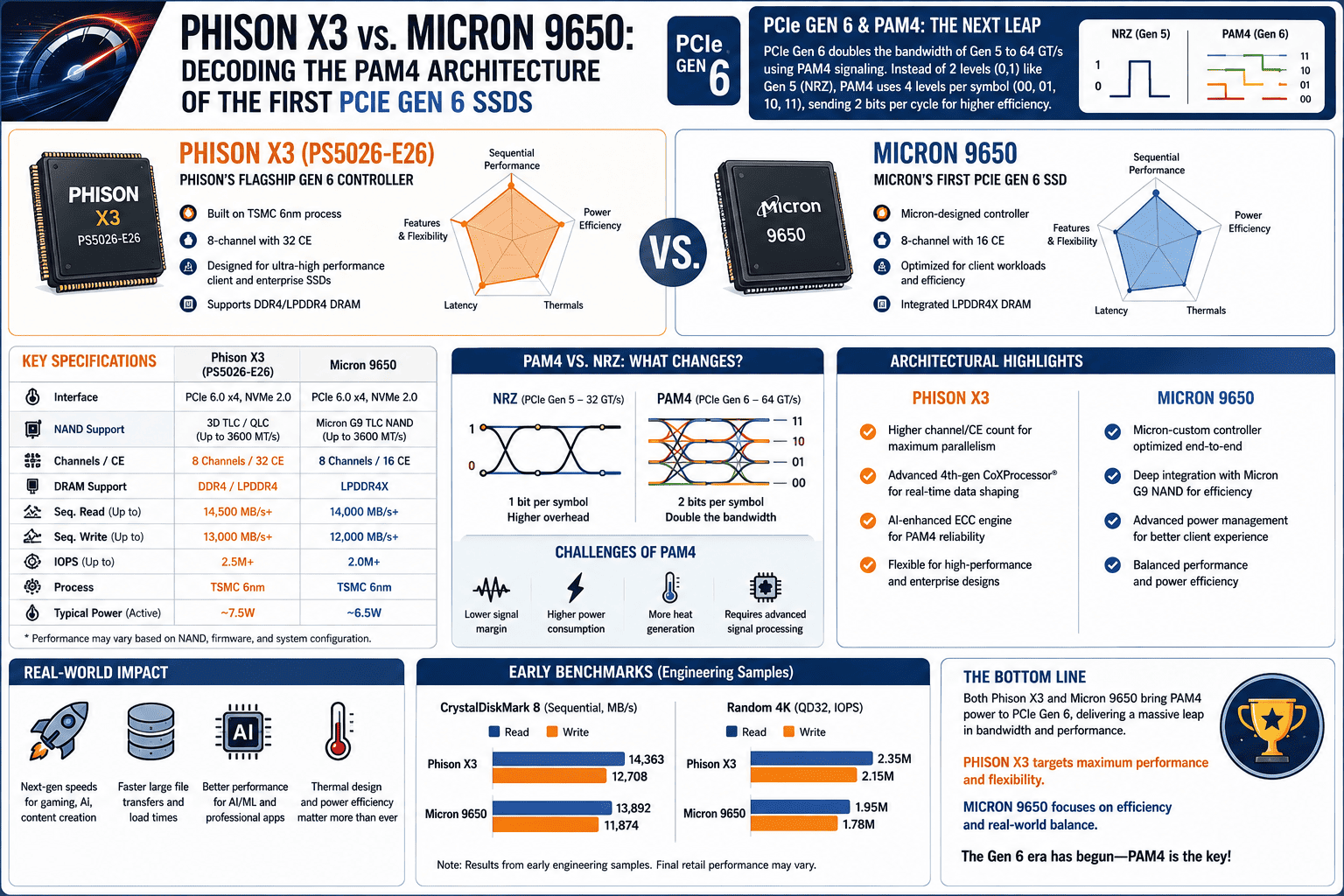
Phison X3 vs. Micron 9650: Decoding the PAM4 Architecture of the First PCIe Gen 6 SSDs
Just when you thought your system’s storage couldn’t possibly get any faster, the tech industry has officially kicked down the door to the next generation. PCIe Gen 5 SSDs already push a blistering 14,500 MB/s, but they are about to look like turtle-paced legacy hardware.
With the recent finalization of Phison’s X3 controller and Micron launching the ground-breaking 9650 drive, tech enthusiasts are intensely searching for how the first wave of PCIe Gen 6 SSDs plans to achieve an earth-shattering 28,000 MB/s (28 GB/s) of sequential throughput.
Doubling the speeds of Gen 5 isn’t just a matter of overclocking a silicon chip. It required a complete overhaul of how data physically travels across your motherboard. Let’s decode the secret weapon behind Gen 6 storage—PAM4 signaling—and pit the two early titans against each other to see how they handle the brutal reality of next-gen engineering.
The Secret Weapon: What is PAM4 Data Encoding Storage?
To understand how the Micron 9650 sequential speed limits manage to hit 28 GB/s, we have to look at the highway your data drives on.
Every generation of consumer PCIe storage before this used a signaling method called NRZ (Non-Return-to-Zero). Think of NRZ like a simple light switch that transmits data using binary: the light is either On (1) or Off (0). Each clock cycle can only send a single bit of data. To make it faster, you had to physically increase the frequency, which created massive electrical noise and stability issues.
PCIe Gen 6 completely ditches this model for PAM4 (Pulse Amplitude Modulation 4-Level) encoding.
Instead of a basic light switch, PAM4 works like a dimmer switch with four distinct brightness levels (voltages). By having four levels instead of two, a single electrical pulse can carry two bits of data at the exact same time (00, 01, 10, or 11).
[ NRZ Signaling ] --->  Level 0 (Bit 0)  or  Level 1 (Bit 1)
[ PAM4 Encoding ] --->  Level 0 (00) | Level 1 (01) | Level 2 (10) | Level 3 (11)
By packing double the data into the same time slice, Gen 6 instantly doubles the bandwidth of the bus without needing to push frequencies to unstable, heat-generating extremes.
Phison X3 vs. Micron 9650: The Architecture Clash
While both drives leverage PAM4 architecture to rewrite the rules of a PCIe Gen 6 SSD benchmark, the internal Phison X3 controller specs show a completely different engineering philosophy compared to Micron’s in-house silicon.
1. The Phison X3 Controller
Phison is the undisputed king of off-the-shelf consumer NVMe controllers. The X3 is their crown jewel. Fabricated on TSMC’s ultra-efficient 4nm process, the X3 is designed to pair perfectly with the latest 2yy-layer TLC and QLC NAND blocks.
-
The Key Stat: Phison’s primary objective with the X3 isn’t just raw speed; it’s thermal survival. The controller features an advanced hardware-level Forward Error Correction (FEC) mechanism explicitly tuned to handle the tight voltage tolerances of PAM4 signals without causing processing delays.
2. The Micron 9650 SSD
Micron has taken a monolithic approach by designing both the controller architecture and the raw V-NAND layers completely under one roof. The Micron 9650 is built as a heavy-duty flagship drive meant to handle demanding next-gen computing workloads.
-
The Key Stat: By building a tightly vertical hardware stack, Micron optimizes the link between the PAM4 data lanes and their custom 232-layer TLC flash memory, aiming for sustained, brutal read and write consistency that doesn’t falter even during long data-dump sequences.
The Ultimate Engineering Hurdle: The 7-Watt Thermal Target
If you’ve owned a Gen 5 SSD, you know they run incredibly hot, often requiring massive heatsinks or loud, whiny mini-fans to avoid thermal throttling. Because PAM4 signaling relies on analyzing four distinct voltage steps, the controllers have to work twice as hard to parse the data stream, which naturally generates massive amounts of radiant heat.
Early engineering prototypes of Gen 6 controllers were absolute furnaces, pulling up to 14 watts of power and instantly thermal-crashing into a Blue Screen of Death (BSOD) within seconds if left bare.
This is where the true battle lies. The victor of the Gen 6 era won’t be the drive that hits 28 GB/s first—it will be the drive that can maintain it without melting.
Phison has taken a massive stand here, publicly targeting a 7W active power draw threshold for the X3 controller under heavy load. By dropping the power draw down to 7 watts through architecture shrinks, Phison is trying to ensure that Gen 6 drives can still be cooled by standard motherboard heat shields rather than requiring tower-coolers that block your graphics card slot. Micron is countering this with advanced, dynamic low-power sleep states built directly into the firmware of the 9650 to shed thermal energy during micro-seconds of processing downtime.
Head-to-Head Technical Spec Speculation
| Metric | Phison X3 Platform | Micron 9650 Platform |
| Data Signaling | PAM4 Encoding | PAM4 Encoding |
| Max Target Sequential Read | Up to 28,000 MB/s | Up to 28,000 MB/s |
| Fabrication Node | TSMC 4nm | Custom Enterprise-Grade Node |
| Core Power Target | ~7 Watts (High Efficiency) | ~9 Watts (High Sustained Load) |
| Error Correction | Specialized PAM4 FEC | Proprietary Matrix ECC |
The Verdict for Benchmarkers
When these drives hit consumer shelves and users start dropping them into CrystalDiskMark to post screenshots online, the numbers are going to look surreal. We are talking about filling a 1TB drive from completely empty to completely full in under 40 seconds.
However, when you are auditing these drives natively in CrystalDiskInfo, thermal monitoring is going to be your absolute highest priority. Because PAM4 encoding leaves very little room for electrical instability, running these drives close to their 70°C thermal redline will degrade your health status and trigger aggressive performance drops much faster than older tech.
The Phison X3 looks like the champion for clean, daily desktop use due to its strict 7W cooling target, while the Micron 9650 is shaping up to be a relentless production workhorse. Whichever way you lean, start saving up for a high-airflow PC case—the Gen 6 era is fast, furious, and undeniably hot.